Table of Contents
Counters and backsplash sit side by side in your sightline every day. Choosing them separately often leads to a kitchen where two nice materials fight each other. Choosing them as a pair is what makes a kitchen feel intentional.
Think of them as a pair, not two picks
Counters and backsplash sit side by side in your sightline every day. Choosing them separately often leads to a kitchen where two nice materials fight each other. Choosing them as a pair is what makes a kitchen feel intentional.
The simplest approach is to let one of them lead. A bold, patterned counter pairs with a quiet backsplash. A busy, textured backsplash pairs with a calm counter. When both are loud, the eye has nowhere to rest and the kitchen feels busy.
We lay samples next to each other in the actual kitchen light before you commit. A material that looks perfect in a showroom can look different under your windows, next to your cabinets, in your home.
Material options that hold up
Quartz counters are durable and low maintenance, with no sealing required. Granite is natural and heat-tolerant but needs periodic sealing. Butcher block adds warmth and works for some, though it needs more care near water.
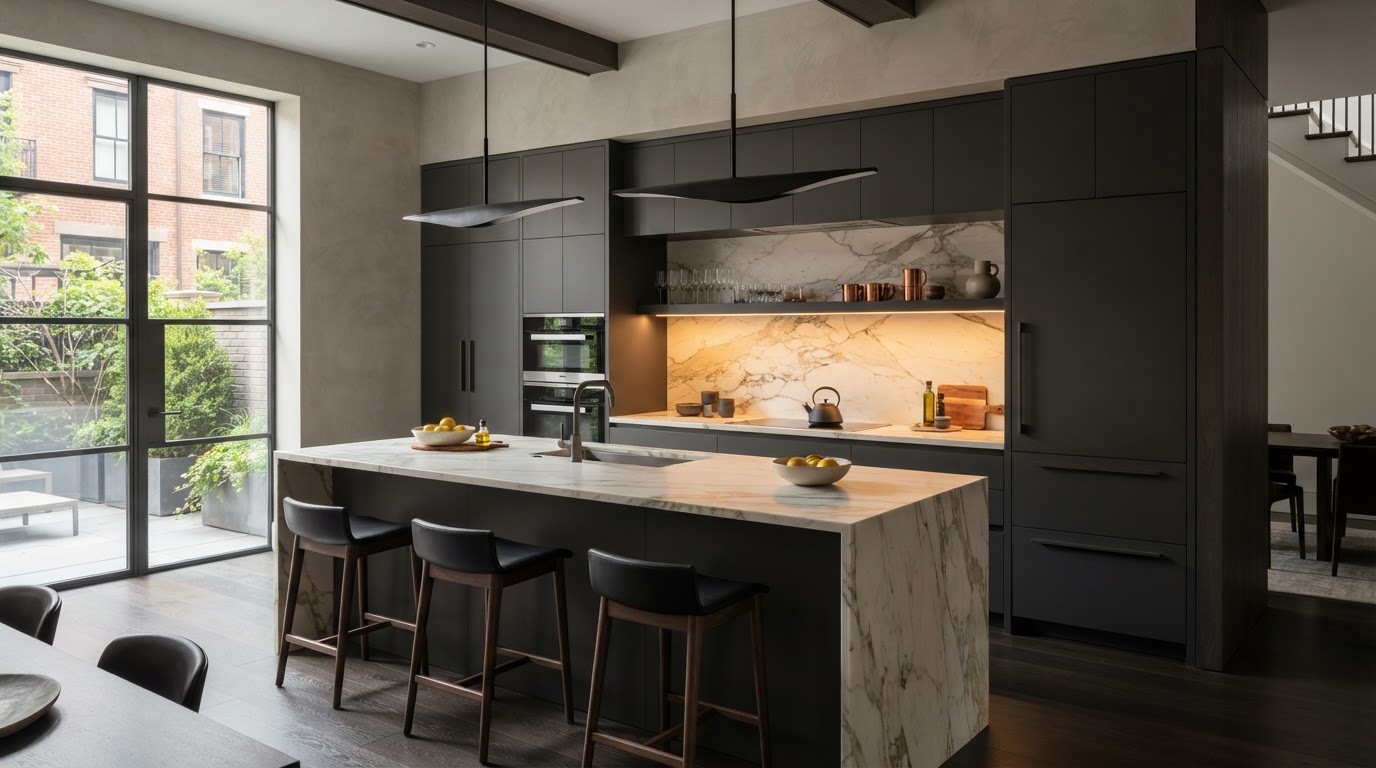
For backsplash, porcelain and ceramic tile are the reliable choices. Natural stone tile works but needs sealing. Large-format slab backsplash, running the counter material up the wall, gives a clean, continuous look with fewer grout lines.
The grout itself matters. A light grout shows stains quickly. A mid-tone or matched grout hides daily kitchen soil. The grout color is a small decision with a big effect on how the kitchen ages.
Letting one lead
If your counter has a lot of movement, a quiet backsplash lets it be the star. A solid or subtly textured backsplash in a tone pulled from the counter keeps the kitchen cohesive without competing.
If your counter is solid and calm, the backsplash can carry more interest. A textured tile, a vertical stack pattern, or a contrasting tone adds personality without overwhelming the space.
The cabinet color is the third voice in the conversation. A dark cabinet with a busy counter and a busy backsplash is a lot. Simplifying one of the three gives the kitchen breathing room.
Practical choices for narrow kitchens
In a narrow Philadelphia rowhome kitchen, the backsplash is often what you see the most, because you stand right next to it. That makes it a good place to spend a little more on something you love.
At the same time, a narrow kitchen has less wall, so a premium material there does not break the budget the way it would in a large, open kitchen. A small, well-chosen backsplash can elevate the whole room.
Keep the counter choice durable first, since it takes more abuse. In a tight kitchen, the counter is workspace, prep surface, and sometimes a stand-up eating spot all at once. It has to take the use.
Lighting changes everything
Under-cabinet lighting is what makes a backsplash look good in the evening. A beautiful backsplash in a dark kitchen is wasted. Plan the lighting with the materials so both get to show.
The color temperature of the bulbs shifts how the materials read. A warm bulb makes stone look golden. A cool bulb makes it look gray. Test the materials under the lighting you will actually use.
This is a detail that gets missed when counters and backsplash are chosen in a vacuum. Seeing them together, lit the way your kitchen is lit, is how you avoid a surprise after install.
Should backsplash match the counter?
Matching is one option, especially with a slab backsplash. But matching is not required. Letting one lead and keeping the other quieter often looks more intentional.
What grout color hides stains best?
A mid-tone or matched grout hides daily kitchen soil better than bright white. Light grout shows stains quickly in a working kitchen.
Can I use the same material for counter and backsplash?
Yes, a slab backsplash running the counter material up the wall gives a clean look with fewer grout lines. It works well in narrow kitchens where continuity helps the space feel larger.
LET'S TALK ABOUT YOUR PROJECT
Tell us what you are planning. We will review the scope and follow up with next steps.